Eagle Genomics—2022 to 2024
From microbiome analysis to predictive insight
Eagle Genomics moved from isolated analyses towards a connected, evolving body of defensible microbiome insight.
01
From an interface brief to a scientific user journey
Eagle Genomics wanted to help research organisations move from describing microbiomes towards understanding relationships, predicting effects and supporting defensible product claims. Its e[datascientist] platform combined data processing, statistical analysis and network science, with a longer-term ambition to build a multilayer hypergraph connecting biological evidence from different sources.
The applications sat on a shared infinite canvas, but they still operated largely as separate tools. The fuller ambition was for the canvas to preserve the path of an investigation so scientists could return to earlier findings and eventually branch or compare lines of enquiry.
I joined as a Senior Product Designer to turn an existing hypothesis-testing prototype into a brand-compliant application. The prototype covered one happy path, but designing the real experience revealed multiple kinds of hypotheses, different numbers of variants and many more journeys and states than the original scope anticipated.
It was only later it became clear where hypothesis testing belonged in the end-to-end journey. Scientists first processed their data, explored potential patterns and then assessed how much confidence they could place in an insight. Those supported insights could eventually become connections in the hypergraph, carrying evidence and confidence into further exploration.
What appeared to be an interface-design brief was really a systems and service-design challenge: connecting separate applications, scientific expertise and technical dependencies around the scientist's journey from question to defensible insight. A trustworthy experience depended on the question, data, method, technology, implementation and support working together.
02
Embedding statistical expertise in MSA
A central proposition of e[datascientist] was that microbiologists with limited statistical expertise could analyse data safely without continually relying on scarce specialists.
Established microbiome tools were powerful, but common workflows often involved command-line tools, R or Python packages, or moving between specialist applications. Graphical alternatives reduced the need to code, but users could still be left to make consequential methodological choices themselves.
Working with microbiologists, bioinformaticians and data scientists exposed the expert judgements hidden behind apparently simple choices: whether data was suitable, which analysis was appropriate, what assumptions applied and what a result could support. A more intuitive interface was not enough; it also needed to guide those decisions without concealing them, because an apparently simple workflow could otherwise make an unreliable conclusion appear authoritative.
I therefore designed MSA around the questions microbiologists were trying to answer, guiding them from their data and experimental factors towards an appropriate analysis and an interpretable result. For analyses such as alpha and beta diversity, the experience connected taxonomic level, contextual variables, appropriate metrics, visual results and recommended hypothesis tests. Guided sequencing, validation, defaults and visible assumptions embedded data scientists' knowledge while showing where expert scrutiny was still needed.
Research with scientists at major enterprise clients reinforced the value of this approach. They wanted less computationally experienced colleagues to work more independently without losing confidence in the method or result.
03
Turning experimental evidence into reusable knowledge
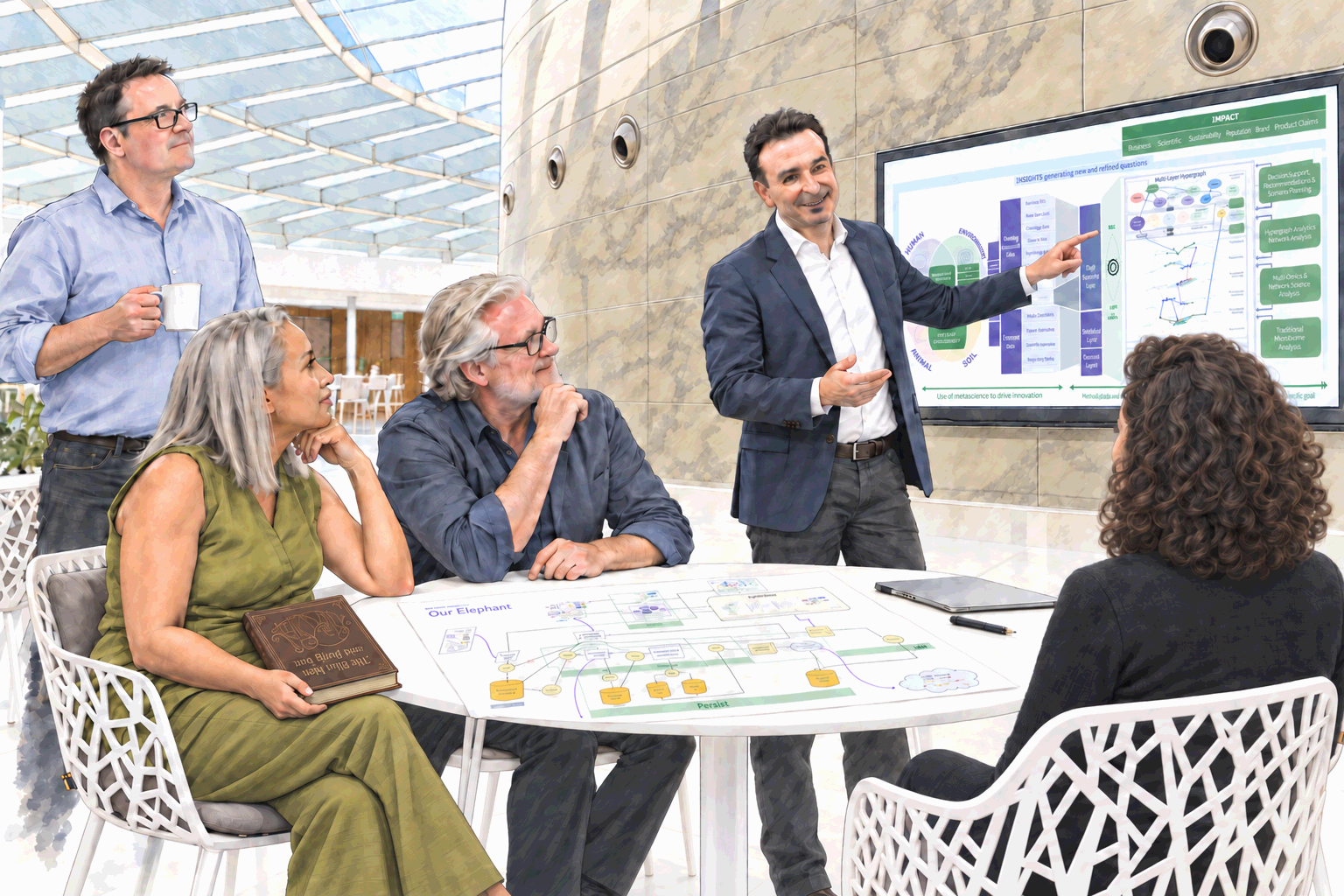
Eagle's hypergraph vision was to turn findings from individual studies into an evolving body of organisational knowledge. It could connect microbes, genes, pathways, interventions, outcomes and other evidence across layers, while keeping each inferred relationship tied to its provenance and statistical confidence. As new studies contributed evidence, relationships could be strengthened, challenged or superseded without losing the conditions under which each insight had been created.
The concept had strategic importance but had not yet been translated into a clear product experience. I interviewed senior stakeholders and facilitated workshops across science, technology, product, services and commercial leadership, mapping how scientists could contribute evidence, explore what the organisation already knew and use it to answer a question or make a decision.
The discovery identified three purposes with different starting points: developing a product from known microbes and outcomes, repurposing known microbes by investigating possible outcomes, and open-ended discovery. This showed that the hypergraph needed to support distinct scientific journeys rather than one generic exploration experience.
I connected these journeys to the wider path from pipelines and statistical analysis through evidence and exploration, then translated the model into a future-state product direction and concept designs. My design team created the high-fidelity designs, which the prototyping team developed into a functioning front end for exploring networks containing thousands of microbes.
The prototype made the proposition tangible while exposing key questions about whether layered networks could help scientists find meaningful relationships, what evidence those relationships required and whether the experience could perform on customer data.
04
Making the vision testable in delivery
We needed to make a strategic choice: whether to extend the existing Exploration network viewer with connected knowledge, or first improve the Exploration experience and its performance. I presented the alternatives as customer journeys so that user value and technical feasibility could be considered together.
Evaluating the connected-knowledge option exposed dependencies beyond the interface. Eagle needed to understand and prepare the customer's data, generate and connect the relevant knowledge, process very large networks across different cloud environments and support each new query. Without resolving these dependencies, the intended experience could not be delivered reliably or at a sustainable cost.
We therefore positioned the next customer iteration as a bounded extension of the Exploration viewer, not a release of the complete hypergraph vision. MSA exposed a similar capability gap between intent and Eagle's ability to deliver. Although its designs received positive customer feedback, the delivered MVP was slow, unreliable and materially different from the intended experience.
Caption
The ultimate vision of the multi-layer hypergraph was to create microbiome digital twins
05
Making uncertainty visible before the runway ended
Eagle exhausted its funding runway and entered administration before MSA or the complete hypergraph vision had enough time to demonstrate adoption, scientific outcomes or commercial impact.
My biggest impact was making Eagle’s scientific ambition tangible and its uncertainties visible. By bringing scientific expertise, customer journeys and data-science prototyping into product definition, I gave customers and internal teams a future-state vision they could challenge and test before committing to delivery.
The unanswered question is what Eagle might have achieved had customer need, scientific evidence and delivery reality been brought together earlier in its runway.