Making supply chains visible
Brambles set out to turn its global network of tracked pallets into connected digital services, helping customers locate goods, optimise operations and respond to emerging problems
My role Led ten senior and principal designers across five countries, supporting internal and customer-facing applications
Impact
9 products
Supported six product launches and three redesigns across the portfolio
First 5 customers
Supported move from trials and pilots into subscriptions
3 retail-account wins
Credited to the real-time asset visibility designs I initiated
Design → code
AI-assisted, accessible prototypes ready in days, not weeks
The challenge
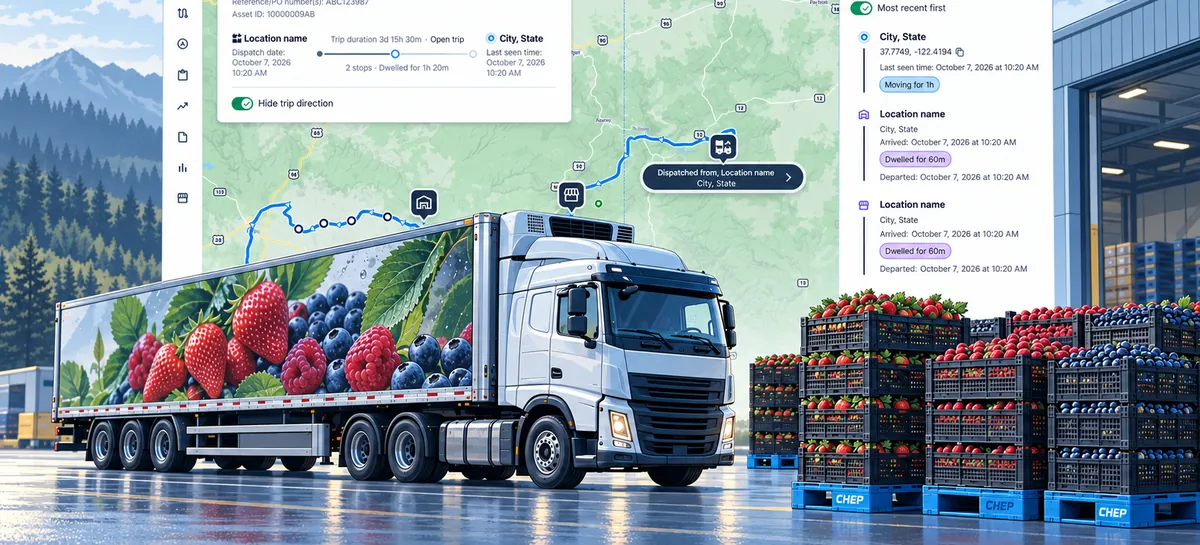
When I joined, Brambles was building a portfolio of digital services around its supply-chain data. Its first digital customer application, Supply Chain Illumination (SCI), had not yet reached a minimum viable product. SCI was a collection of disconnected pages linked from a basic home page, with no clear hierarchy or separation between administration and application features, and little support for customer journeys.
Across the wider portfolio, applications intended to work together were being developed with different structures, navigation and interaction patterns.
What I uncovered
In parts of the company, UX was understood primarily as UI design. Product and Engineering often defined applications before involving UX or engaging customers or users, limiting the opportunity for research to shape product direction. Project teams worked in silos, with limited coordination across applications.
Research, product definition, design and delivery were insufficiently joined up. Briefs often prescribed interface details before customer needs had been explored, and research findings did not consistently reach designers in time to shape the work. Gaps in collaboration made it harder to align the Design System with project needs, break proposals into manageable increments and preserve design intent through implementation.
My approach
My aim was to help teams across Brambles Digital work towards shared goals while retaining the independence to move their own work forward. That meant building shared understanding and mutual respect, with customer evidence and expertise travelling across disciplines, countries and time zones.
What I changed
Established shared foundations for connected applications
I secured investment in shared navigation, information architecture, components and patterns by making them tangible through SCI’s real-time goods and pallet visibility proposition. These foundations enabled integration and reuse across the portfolio.
I gave teams a common basis for communicating the meaning and limitations of operational data, bringing experts together to agree standards for metrics, charts and confidence levels. The standards made data limitations and aggregation context explicit, helping users judge when information could support a business decision.
Brought customer evidence and shared understanding into product decisions
I brought customer evidence and shared understanding into decisions across product teams through researcher–designer pairings, cross-project design shares and peer review of briefs. These involved research, design, Product, Engineering and QA across applications.
I aligned Design System priorities with project needs by channelling requirements into its backlog and bringing designer feedback into reviews of its output.
Built design capability and shared judgement
I strengthened designers’ confidence and ownership of direction through coaching and live product work. Concept and quality-assurance reviews helped less experienced designers develop their judgement alongside senior colleagues and Design System specialists, giving the chapter a shared basis for assessing quality and challenging assumptions.
Her coaching, encouragement and belief in me played an important part in my promotion from Senior UX Designer to Principal Product Designer.
Enabled customer validation in days rather than weeks
I enabled concepts to reach customer validation in days rather than weeks through a research-led, AI-assisted prototyping approach developed with my senior designers.
Under my direction, designers built working environments grounded in validated journeys, accessibility and the Design System. These allowed designers and Product Managers to explore realistic interfaces, with SCI Mobile and Retail Promotions demonstrating the approach in practice.
Karen has shown a great leadership in her role at Brambles setting the direction for UX component standardisation, accessibility guidelines and also AI use in supporting UI design and development.
Outcomes
SCI reached MVP and secured its first five subscription customers. The asset pool visibility capability was credited internally with supporting three major retail-account wins. Across the wider portfolio, the design function supported six product launches and three redesigns across the portfolio.
The design chapter became a more cohesive, confident function, with shared standards and stronger collaboration across disciplines. Designers took greater ownership of product direction, supported by customer evidence and peer review.
A subsequent restructuring reduced central research and design capacity, but the foundations outlasted it. By late 2026 the shared navigation was in place on eight of the nine products, and myCHEP, which serves a different problem space, had its own navigation redesigned under my direction. The Design-System-compliant AI playgrounds my designers built are in use across the company and now underpin new ways of working.
Selected project work
Alongside leading the chapter, I worked directly on product propositions and design direction across the portfolio. These two examples show how I combined hands-on design with coaching and leadership.
SCI Mobile
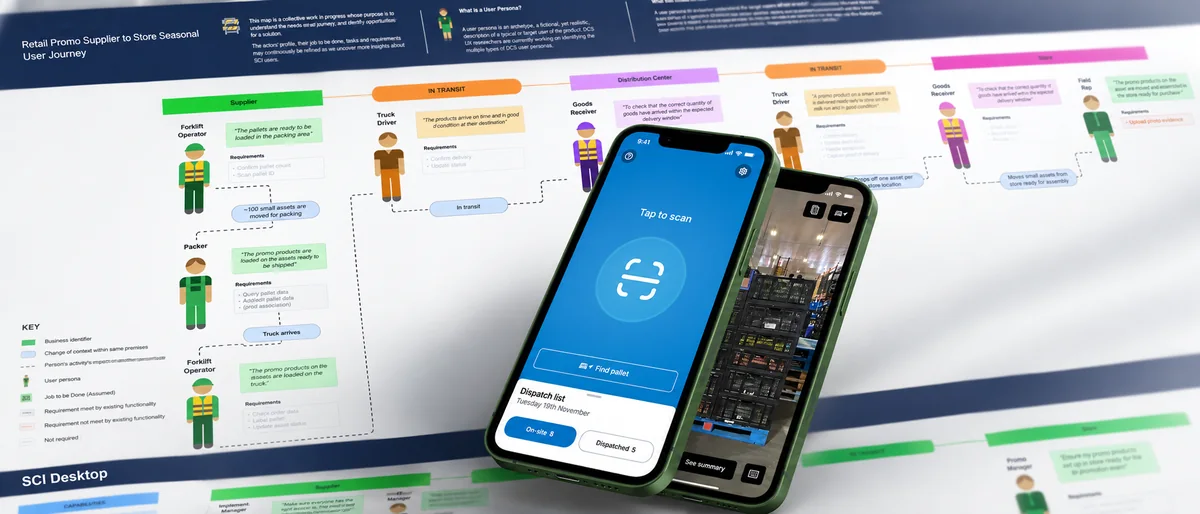
I championed a broader mobility strategy for SCI, expanding the focus from pallet scanning to the customer operations it needed to support. Research and journey mapping revealed how physical handling, roles and data capture shaped the mobile experience.
Working first with solution management and then Product, I directed UX and coached the Design Principal leading the mobile proposition workshops. I also coached the designers leading the AI-assisted prototype build. The resulting SCI Mobile prototype was validated through customer feedback. The updated application is now in development, with initial customer trials planned for the end of November 2026.
Retail Promotions
I worked with a senior service designer to shape a proposition for using smart assets to improve retail campaign execution, expanding the focus from compliance reporting to decisions and action throughout a promotion.
I translated the insights into concepts, content and low-fidelity journeys that guided an AI-assisted interactive prototype, enabling us to validate the business proposition in days rather than weeks.

Applied skills
Design leadership, product and design strategy, systems and service design, design systems and AI-assisted product development
Team
Designers, researchers, product and solution managers, engineers, data scientists, customer teams, pre-sales and marketing