Brambles—2024 to 2026
Making supply chains visible
Brambles set out to turn its global network of tracked pallets into connected digital services that gave customers greater visibility of their supply chains and helped them act on emerging problems.
01
From prototype to product
Brambles was developing digital services from tracked-pallet data. Supply Chain Illumination (SCI) combined those tracking signals with customers' operational data to help them locate goods and assets, understand what had happened and decide when to intervene.
When I joined, SCI had not yet reached MVP. It was a collection of largely disconnected screens organised around technical modules rather than a coherent product experience. Its navigation, terminology and content made it difficult for customers, and even the teams demonstrating it, to understand its value.
I led four senior UX designers working on SCI in an organisation where UX was commonly engaged after the problem and product direction had been set. What appeared to be an interface-design challenge was really a product transformation: turning a technical proposition into something customers could understand and use, while establishing a role for design before solutions were fixed.
02
Building the case for a mobility strategy
Pallet association was initially treated as a mobile usability problem. Working with the Solution Manager, we mapped the journey from physical handling through association and tracking to customer action. This exposed a wider operational challenge: people had to identify and scan pallets during fast-moving warehouse work, while roles, workflows and methods of capturing data varied between customers.
Although the visible output included mobile interactions, this was service design. SCI could only produce useful intelligence if the digital experience worked within the physical operation.
Senior stakeholders were initially sceptical that the problem warranted a broader mobility strategy. I initiated a cross-department workshop that brought operational, customer, product and technical perspectives together, revealing why no single mobile journey could serve every context.
We turned the findings into AI-assisted interactive concepts and tested them with existing and prospective customers. The evidence secured support for the strategy and led to the development of a flexible mobile framework capable of supporting different interfaces and operational models.
03
Designing a connected application ecosystem
Brambles was developing a growing number of customer-facing and internal applications intended to work together on a shared platform. Yet each had evolved independently, without recognisable information architecture, standard navigation or common interaction patterns. Users moving between them encountered different structures and behaviours rather than one coherent Brambles experience.
Working with service and UX designers, I developed the original discovery into a broader information-architecture and navigation initiative. We introduced familiar enterprise structures and began defining generic navigation, components and patterns that could be reused across products.
There was not sufficient value in information architecture alone to prioritise it on the roadmap. To create a compelling roadmap driver, I worked with Product to apply the thinking within SCI through a real-time, map-led home page addressing a clear customer need. This secured investment in shared navigation and components, enabling a consistent experience and code reuse across Brambles Digital applications. As an additional benefit, the map became the basis of a major new SCI capability credited with supporting new retail-account wins.
04
Building a design capability that could scale
Successful product interventions demonstrated what design could contribute, but they would not change how Brambles worked unless the capability could scale. As my remit expanded beyond SCI, I took responsibility for four existing designers elsewhere in Brambles Digital and recruited two more. This brought ten senior and principal UX designers across five countries into one design function.
I introduced shared practices that brought research, problem framing and validation earlier into product development, strengthened peer review and design quality through delivery, and created consistent standards for how products communicated metrics. These gave designers and their multidisciplinary teams clearer ways to examine problems, challenge assumptions and maintain intent through implementation.
I reinforced the practices through coaching and live product work, developing the Principals as leaders and helping designers connect their decisions to evidence. The team became more cohesive and confident, design quality improved and collaboration across disciplines grew stronger. Designers moved from responding separately within delivery teams towards operating as a distributed capability with shared ways to shape and deliver better products.
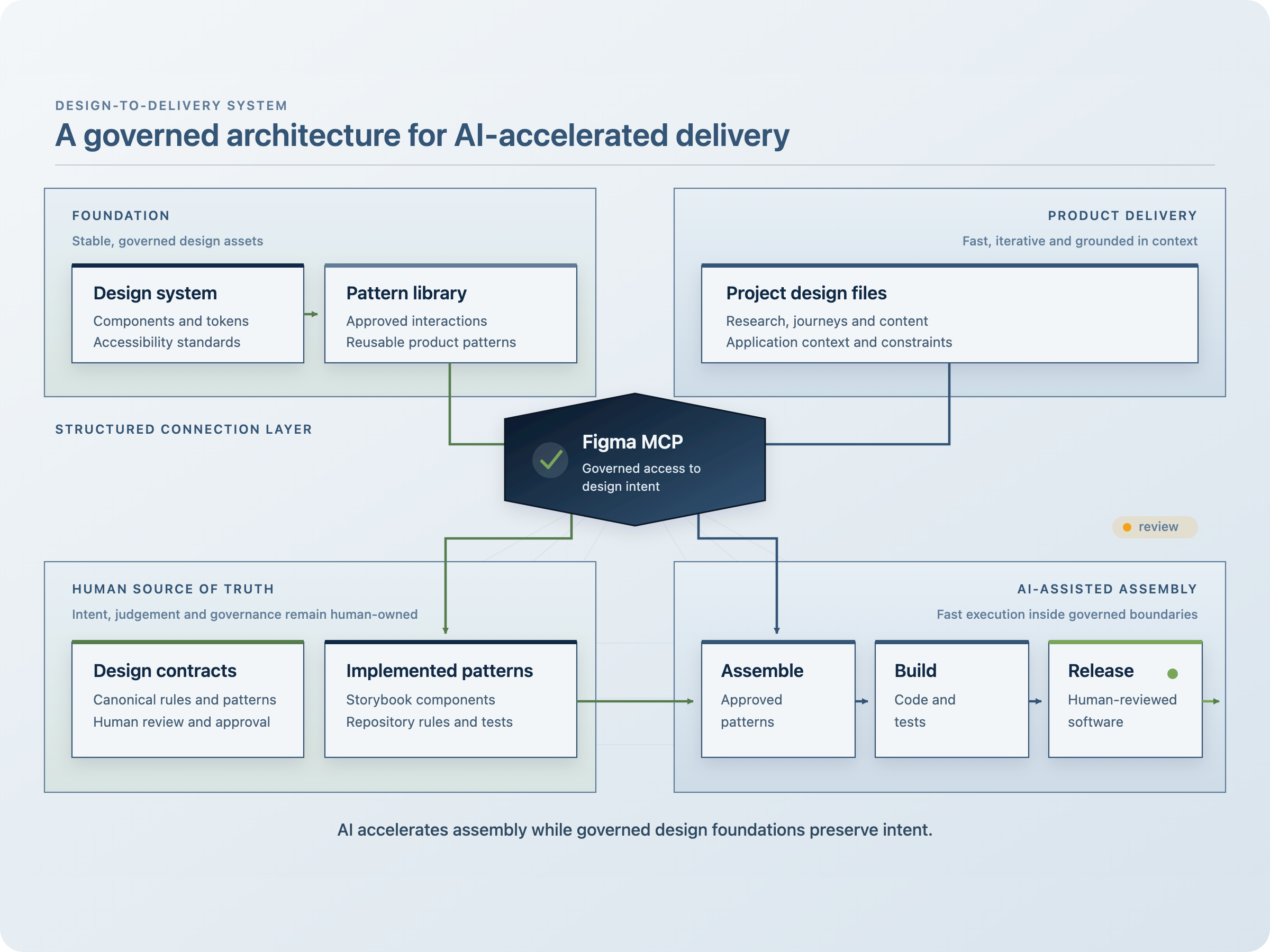
Caption
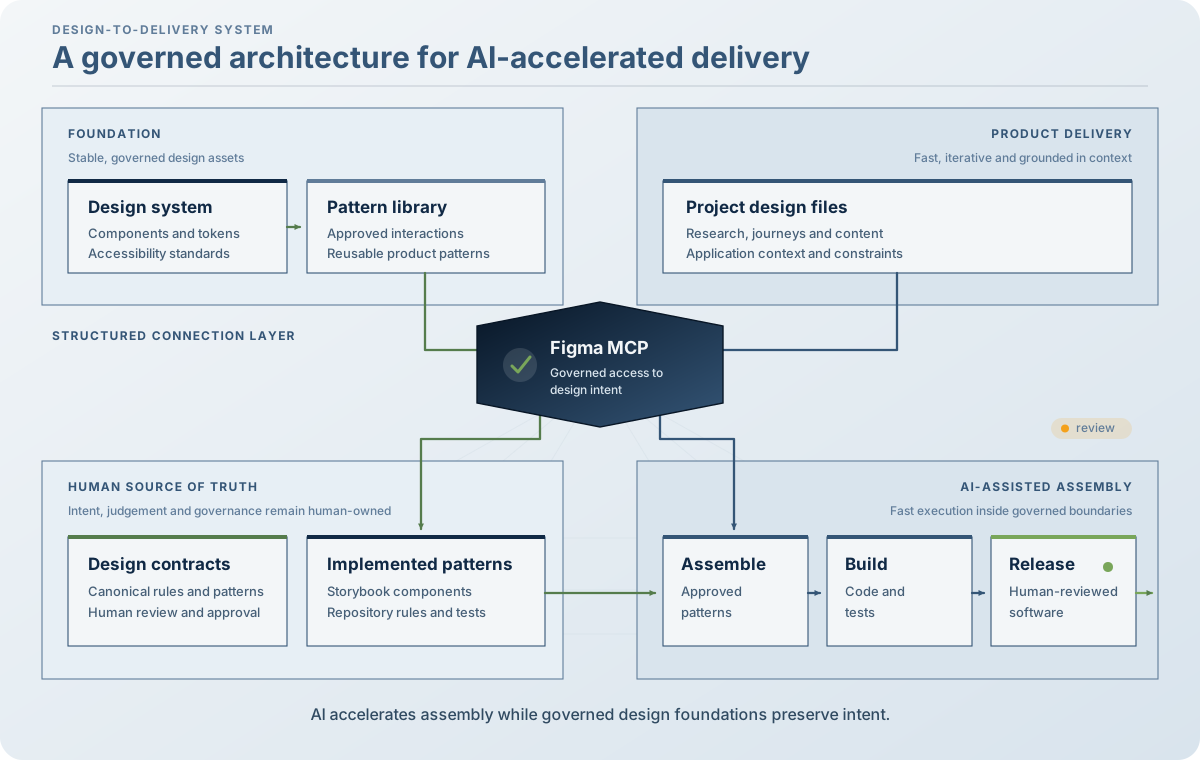
AI acceleration of design and development without sacrificing quality and increasing design debt
05
Using UX to guide AI-accelerated delivery
Generative AI was changing faster than established product practices could respond. Speed created opportunity, but unconstrained generation could also turn poorly understood ideas into inconsistent or inaccessible software. My team developed an approach that grounded AI-assisted design work in research, validated journeys, accessibility, reusable design system foundations and the constraints of the real application.
Retail Promotions became a practical test of this approach. Working hands-on with the user researcher/service designer, I translated research insights into concepts, shaped the content and created lo-fi user journeys. One of my Design Principals then used this work to guide the AI-accelerated build, producing an interactive, code-based prototype that enabled us to validate the business proposition in days rather than weeks.
The work demonstrated that UX could give AI-accelerated product development both speed and direction. Grounding delivery in customer evidence, design intent and technical feasibility gave us confidence that we were rapidly advancing a proposition worth building.
06
From experimentation to commercial traction
During my tenure, SCI reached MVP, progressed beyond trials and pilots, and secured its first subscription customers. Across the wider portfolio, the design function also supported the launch and modernisation of multiple internal applications built in Svelte and React.
Across the portfolio, designers and researchers worked together to keep product decisions connected to user evidence. Shared review and quality practices developed design capability before work entered development, while new patterns could be accelerated into the Design System. We also created Design-System-compliant AI playgrounds that democratised prototyping, enabling colleagues across the company to turn ideas into realistic, interactive concepts.
Before these practices could become fully embedded or their impact measured over time, a company-wide restructuring driven by uncertainty in the supply-chain sector shifted investment towards near-term delivery and brought my time at Brambles to an end. I left SCI with commercial traction and Brambles Digital with stronger foundations for evidence-led design, consistent delivery and AI-assisted prototyping.